Entering Brazil? Here's the regulatory minefield Stripe, PayPal, and Temenos don't warn you about.
Brazil is the world's 5th largest payments market — and a black box for foreign players. CADOC reports, CCS registries, judicial account freezes, PLD/FT compliance, MED 2.0 chain blocking. Companies like Stripe, PayPal, and Temenos spend millions and years navigating it. We built a single API layer that handles all of it in < 5ms.

Brazil: the payments goldmine that eats foreign companies alive
Brazil processes over $1 trillion in digital payments annually. PIX alone moves more volume than Venmo, Zelle, and CashApp combined. It's the world's 5th largest payments market, growing at 30%+ year over year.
Every global payments company wants in. Stripe, PayPal, Adyen, Temenos, Finastra — they all see the numbers and start salivating.
Then they hit the regulatory wall. And most of them don't even see it coming.
The black box: what nobody tells you before you enter
Here's what the "Brazil market entry" decks from McKinsey and BCG conveniently gloss over:
CADOC — The Central Bank (BACEN) requires financial institutions to submit dozens of standardized documents on rigid schedules. These aren't quarterly SEC filings. They're weekly, sometimes daily, with formats that change without warning. Miss a deadline? Automatic fine. Wrong format? Rejected. Resubmit with explanation.
CCS — Every client relationship — every account opening, every status change — must be reported to BACEN's national client registry. In real-time. By CPF (individual tax ID) or CNPJ (business tax ID). Not batch. Not daily. Real-time. If your system processes the account opening but reports it to CCS 6 hours later, you're already non-compliant.
SisbaJud — Brazilian judges can freeze any bank account with a digital order sent directly to your institution. You have *hours* to comply. Not days. Hours. Fail to freeze? Contempt of court. Freeze the wrong account? Lawsuit from the account holder. Freeze too slowly? Both.
PLD/FT — Brazil's anti-money laundering framework (equivalent to AML/CFT) requires suspicious transaction reporting to COAF (Brazil's financial intelligence unit), PEP screening against Brazilian political databases, sanctions list monitoring, and continuous transaction surveillance. If your system misses a pattern that a regulator later identifies, it's not just a fine — it's criminal liability for your local compliance officer.
MED 2.0 — PIX's Special Return Mechanism. When fraud is detected on a PIX payment, funds must be traced and blocked across up to 5 levels of dispersion. In real-time. Across multiple institutions. With full chain-of-custody documentation. Try implementing that on top of your existing global platform.
This is why most foreign companies spend 18-24 months and $2-5 million just to get their compliance layer operational in Brazil. And even then, they're patching holes quarterly.
Why your global compliance stack won't work here
If you're Stripe, you have a compliance stack that handles PCI DSS, SOC 2, GDPR, PSD2, and state money transmitter licenses. Impressive. None of it helps you with CADOC.
If you're Temenos, you have T24/Transact running in 40+ countries. Your regulatory reporting module handles MAS in Singapore, FCA in London, OCC in New York. It has no idea what CCS is. It's never heard of SisbaJud. MED 2.0 doesn't exist in its universe.
If you're PayPal, you've spent 20 years building compliance infrastructure for OFAC, FinCEN, and the EU's AMLD directives. Great. Now try explaining to your engineering team that a Brazilian judge can freeze an account via an API call to your system, and you have 4 hours to respond — or face contempt charges in a jurisdiction where "contempt of court" has real teeth.
The problem isn't that global companies lack compliance expertise. It's that Brazilian regulatory compliance is genuinely different from anything else in the world. It's not a variant of European regulation. It's not a stricter version of American rules. It's its own ecosystem, with its own logic, its own timing, and its own consequences.
What we built: a single API layer for Brazilian regulatory compliance
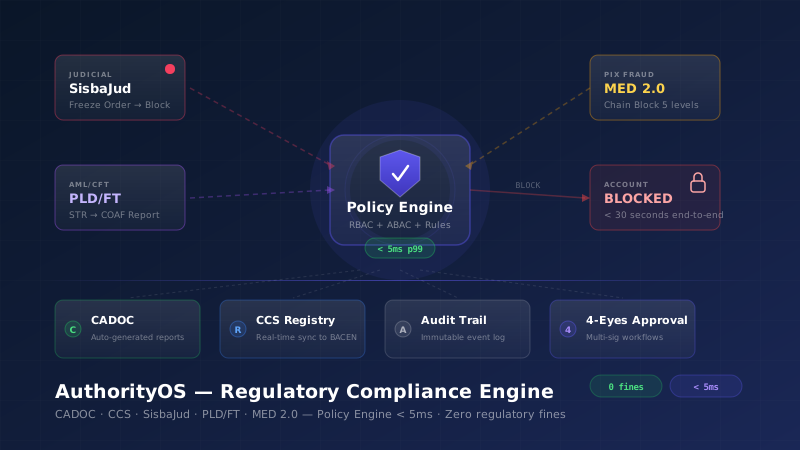
AuthorityOS is a policy engine that sits between your platform and Brazil's regulatory infrastructure. Every operation passes through it before execution. Every decision is evaluated in under 5 milliseconds. Every outcome is logged immutably.
For foreign companies entering Brazil, this means:
CADOC: you don't build reporting — you call an API
AuthorityOS generates CADOC-compliant documents automatically from the audit trail of normal operations. You don't hire a team to manually pull data from databases and format it for BACEN. The documents assemble themselves from the trail of decisions your system already made.
Your engineering team doesn't need to learn CADOC specs. They call our API. We handle the rest.
CCS: real-time by default, not real-time as a project
Every account event in your system emits a webhook. AuthorityOS maps it to CCS requirements and updates BACEN's registry in real-time. No batch processing. No overnight lag. No compliance gaps.
For Stripe or PayPal, this means: you process the account opening through your standard flow, and CCS compliance happens as a side effect. Zero additional engineering work.
SisbaJud: automated judicial compliance in under 30 seconds
When a judicial freeze order arrives, AuthorityOS:
1. Validates the order against the policy engine (< 5ms)
2. Executes the account block
3. Generates compliance documentation
4. Emits a webhook to your system
5. Updates the audit trail
From order received to account frozen: under 30 seconds. Fully automated. Fully auditable. No human in the loop unless your policy requires one.
For Temenos customers, this means: you integrate once with AuthorityOS, and your T24 instances get Brazilian judicial compliance without custom development.
PLD/FT: AML that actually works in Brazil
AuthorityOS integrates with Brazilian-specific PEP databases, COAF reporting formats, and local sanctions lists. It maps your global AML framework to Brazilian requirements automatically.
Suspicious activity detected by your global risk engine? AuthorityOS translates the alert into a Brazilian STR (Suspicious Transaction Report), formats it for COAF submission, and logs the complete decision trail for regulatory review.
MED 2.0: PIX fraud chain blocking — handled
PIX fraud triggers chain blocking across up to 5 levels of fund dispersion. AuthorityOS traces the fund flow, evaluates blocking policies for each recipient, executes blocks in parallel, and generates the MED 2.0 compliance trail — all within SPI's response window.
No other BaaS provider in Brazil handles MED 2.0 programmatically. Most rely on manual processes that take hours. AuthorityOS does it in seconds.
The policy engine: jurisdiction-agnostic, Brazil-ready
At the core of AuthorityOS is a declarative policy engine:
transfer.amount > 50000 → require_approval(["compliance", "admin"])account.judicial_order == true → block_immediatepix.velocity > 5_per_minute → flag_and_review
Policies are defined as code, hot-deployed via API, and versioned with full change history. The engine is jurisdiction-agnostic — the same architecture handles CADOC in Brazil, PSD2 in Europe, and FinCEN in the US. The policies change. The engine doesn't.
ISO 20022 AUTH: your Temenos already understands our authorization events
AuthorityOS authorization decisions follow ISO 20022's authorization message semantics. This means when your Temenos, Finastra, or Mambu instance needs to understand why a Brazilian transaction was approved, blocked, or escalated, the event is already in a format they can parse natively.
No translation middleware. No custom adapters. Plug in and go.
What this means for your Brazil entry timeline
Without AuthorityOS:
- 18-24 months to build CADOC, CCS, SisbaJud compliance
- $2-5 million in regulatory consulting and custom development
- 3-5 compliance specialists hired locally
- Ongoing risk of regulatory changes breaking your implementation
With AuthorityOS:
- 4-6 weeks to full regulatory compliance
- Single API integration — no CADOC, CCS, or SisbaJud expertise needed
- Zero local compliance engineers for technical implementation
- Automatic updates when BACEN changes requirements
The numbers from production
- Policy evaluation: < 5ms (p99)
- SisbaJud response: < 30 seconds (order to freeze)
- CADOC generation: minutes (vs. days manually)
- CCS lag: zero (real-time, no batch)
- Regulatory fines since deployment: zero
The bottom line
Brazil is too big to ignore and too complex to wing it. The regulatory framework isn't a variant of something you've seen before — it's genuinely unique, aggressively enforced, and constantly evolving.
You can spend $5 million and 2 years building compliance infrastructure from scratch. Or you can integrate with AuthorityOS in 6 weeks and ship your product while your competitors are still reading CADOC documentation.
We built this because we lived through the pain ourselves. Now you don't have to.